Kenneth Richmond Visits Fort Pillow and Alex Haley Museum
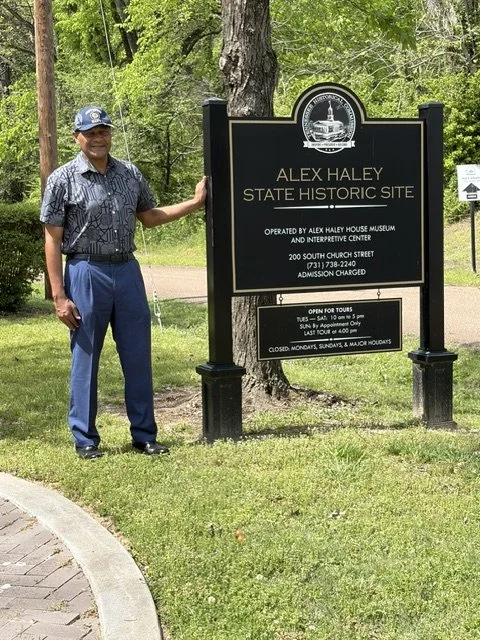
On April 10, 2026, I had the pleasure of visiting the Alex Haley Museum located in Henning Tennessee which ironically is about 20 miles from Fort Pillow. Alex Haley became famous for his 1976 Pulitzer Prize winning novel, “Roots.” This book was adapted for an eight-part television series, which became one of the most popular programs in television history. The movie and book centered around Haley’s ancestors and the triumphs and struggles they faced throughout history.
The museum includes the home of Haley’s grandparents, Will and Cynthia Palmer. Haley lived with his grandparents from 1921 to 1929 while his father, Simon Haley, completed his graduate studies at Cornell. It was on the front porch where young Haley heard about the stories of his ancestors, including stories of Kunta Kinte, the young Mandingo man captured near his West African home. These stories inspired Haley to write Roots.
The Alex Haley home became a historical site on December 14, 1978. Haley is buried on the grounds.
On April 11, 2026, I attended my 3rd annual book signing event at Fort Pillow TN. For newcomers to this newsletter, Fort Pillow TN, located about 55 miles from Memphis, was a battle fought during the American Civil War between Major General Nathan Bedford Forrest’s cavalry and a contingent of Union troops stationed at Fort Pillow, commanded by Major Lionel Booth. The battle began on April 12, 1864 and resulted in a Confederate victory.
In the aftermath, an estimated 300 Union troops were killed in which over 70% casualties were African American soldiers. After 162 years, there is still much debate about this battle--was it an outright massacre of Union soldiers or was it a clash between two opposing armies justified by the realities of war during that era?
Fort Pillow is the setting for my book, “A Time for Courage.” I was so grateful and humbled by the number of people who stopped by my table to purchase my book. In fact, I sold them all. More importantly, I enjoyed meeting and talking to people from all parts of the country who shared a love for history.
It was a joyous day and I learned a valuable lesson, despite our political, religious, and social differences, despite what side of the Civil War our ancestors may have fought on, Union or Confederate, we all share a common bond….we are all Americans now and that won’t ever change.
Please feel free to click on https://www.kenrichmondauthor.com/gallery to visit my photo gallery of the Fort Pillow and Alex Haley museum. Also, I have five historical word search puzzles for you to download at https://www.kenrichmondauthor.com/fun-stuff. This month’s theme is “Famous Last Stands.”
Historical Events in the Month of June
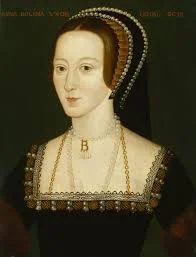
June 1 1533: Anne Boleyn is crowned Queen of England, a significant event in the Tudor dynasty and English history.
June 2 1924: President Calvin Coolidge signed the Indian Citizenship Act, granting U.S. citizenship to all Native Americans born within the country.
June 3 1864: During the American Civil War, General Robert E. Lee won his last victory at the Battle of Cold Harbor, while Union General Ulysses S. Grant suffered heavy casualties in a frontal assault.
June 4 1984: The Nineteenth Amendment to the U.S. Constitution, granting women the right to vote, is passed by Congress and sent to the states for ratification.
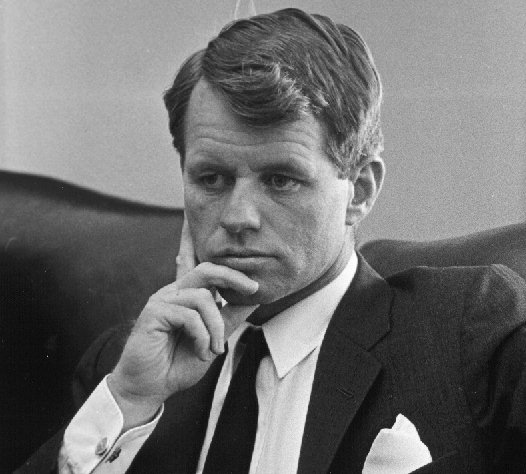
June 5, 1968 - Robert F. Kennedy was shot and mortally wounded while leaving the Hotel Ambassador in Los Angeles. The shooting occurred after a celebration of Kennedy's victory in the California presidential primary.
June 6, 1944 - D-Day, the largest amphibious landing in history, began in the early-morning hours as Allied forces landed in Normandy on the northern coast of France. Operation Overlord took months of planning and involved 1,527,000 soldiers in 47 Allied divisions along with 4,400 ships and landing craft, and 11,000 aircraft. The Germans had about 60 divisions spread along France and the Low Countries. American forces landed on two western beaches, Utah and Omaha, while British and Canadian troops landed farther east on Gold, Juno and Sword beaches. By the end of the day 150,000 Allied soldiers and their accompanying vehicles had landed with 15,000 killed and wounded.
June 7, 1965 - The U.S. Supreme Court struck down a Connecticut law banning contraception. In Griswold v. Connecticut, the Supreme Court guaranteed the right to privacy, including freedom from government intrusion into matters of birth control.
June 8, 1874 - Apache leader Cochise died on the Chiricahua Reservation in southeastern Arizona.
June 9, 1898 - The British signed a 99-year lease for Hong Kong, located on the southeastern coast of China. Hong Kong, consisting of an area measuring 400 square miles, was administered as a British Crown Colony until July 1, 1997, when its sovereignty reverted to the People's Republic of China.
June 10, 1942 - In one of the most infamous single acts of World War II in Europe, all 172 men and boys over age 16 in the Czech village of Lidice were shot by Nazis in reprisal for the assassination of SS leader Reinhard Heydrich. The women were deported to Ravensbrück concentration camp where most died. Ninety young children were sent to the concentration camp at Gneisenau, with some later taken to Nazi orphanages if they were German looking. The village was then completely leveled until not a trace remained.
June 11, 1994 - After 49 years, the Soviet military occupation of East Germany ended. At one time there had been 337,800 Soviet troops stationed in Germany.
June 12, 1963 - Civil rights leader Medgar Evers was assassinated in Jackson, Mississippi, by a rifle bullet from an ambush. He had been active in seeking integration of schools and voter registration for African Americans in the South. Widespread public outrage following his death led President John F. Kennedy to propose a comprehensive Civil Rights law. Evers was buried in Arlington National Cemetery.
June 13, 1966 - The U.S. Supreme Court ruled (5-4) in the case of Miranda v. Arizona that an accused person must be apprised of certain rights before police questioning including the right to remain silent, the right to know that anything said can be used against the individual in court, and the right to have a defense attorney present during interrogation. American police officers now routinely read prisoners their 'Miranda' (constitutional) rights before questioning.
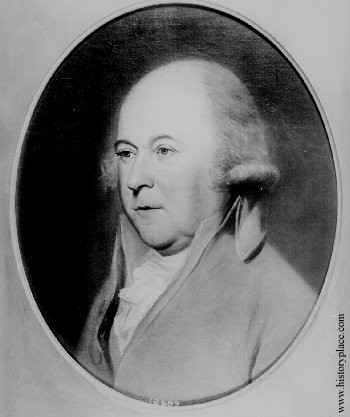
June 14, 1777 - John Adams introduced a resolution before Congress mandating a United States flag, stating, "...that the flag of the thirteen United States shall be thirteen stripes, alternate red and white; that the union be thirteen stars, white on a blue field, representing a new constellation." This anniversary is celebrated each year in the U.S. as Flag Day.
June 15, 1215 - King John set his seal to Magna Carta, the first charter of British liberties, guaranteeing basic rights that have since become the foundation of modern democracies around the world.
June 16, 1963 - Valentina Tereshkova, 26, became the first woman in space as her Soviet spacecraft, Vostok 6, took off from the Tyuratam launch site. She manually controlled the spacecraft completing 48 orbits in 71 hours before landing safely.
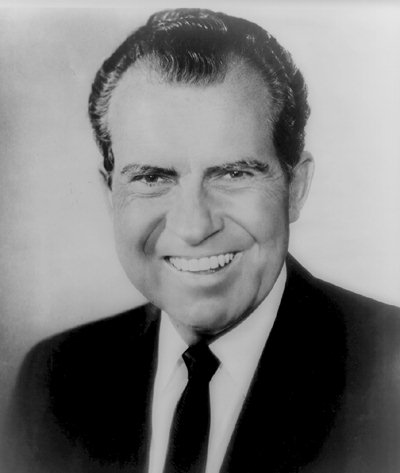
June 17, 1972 - Following a seemingly routine burglary, five men were arrested at the National Democratic Headquarters in the Watergate complex in Washington, D.C. However, subsequent investigations revealed the burglars were actually agents hired by the Committee for the Re-election of President Richard Nixon. A long chain of events then followed in which the president and top aides became involved in an extensive cover-up of this and other White House sanctioned illegal activities, eventually leading to the resignation of President Nixon on August 9, 1974.
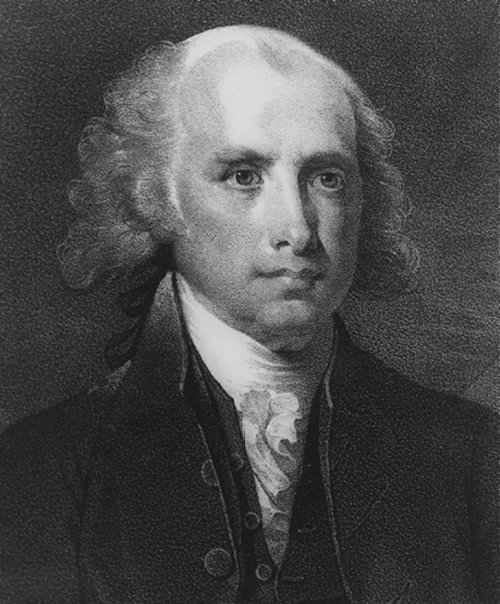
June 18, 1812 - After much debate, the U.S. Senate voted 19 to 13 in favor of a declaration of war against Great Britain, prompted by Britain's violation of America's rights on the high seas and British incitement of Indian warfare on the Western frontier. The next day, President James Madison officially proclaimed the U.S. to be in a state of war. The War of 1812 lasted over two years and ended with the signing of the Treaty of Ghent in Belgium on December 24, 1814.
June 19, 1865 - In Galveston, Texas, upon the arrival of Union troops, Maj. Gen. Gordon Granger read General Order No. 3: "The people of Texas are informed that, in accordance with a proclamation from the Executive of the United States [President Lincoln], all slaves are free. This involves an absolute equality of personal rights and rights of property between former masters and slaves..." As a result, an estimated 250,000 enslaved African Americans in Texas were finally freed. The day is now celebrated as Juneteenth to commemorate Emancipation and to recognize the struggle for freedom and equality of African Americans.
June 20, 1782 - The U.S. Congress officially adopted the Great Seal of the United States of America.
June 21, 1964 - Three white civil rights workers - James Chaney, Andrew Goodman and Michael Schwerner - left Meridian, Mississippi, at 9 a.m. to investigate a church burning. They were expected back by 4 p.m. When they failed to return, a search was begun. Their murdered bodies were discovered on August 4th.
June 22, 1941 - Starting at 3:15 am, some 3.2 million German soldiers plunged headlong into Russia across an 1800-mile front, in a major turning point of World War II. At 7 am that morning, a proclamation from Hitler to the German people announced, "At this moment a march is taking place that, for its extent, compares with the greatest the world has ever seen..."
June 23, 1865 - The last formal surrender of Confederate troops occurred as Cherokee leader and Confederate Brigadier General Watie surrendered his battalion comprised of American Indians in the Oklahoma Territory.
June 24, 2010 - Labor Party deputy Julia Gillard became Australia's first female Prime Minister. She was born in Wales and had moved to Australia as a child. She worked as a lawyer before entering politics.
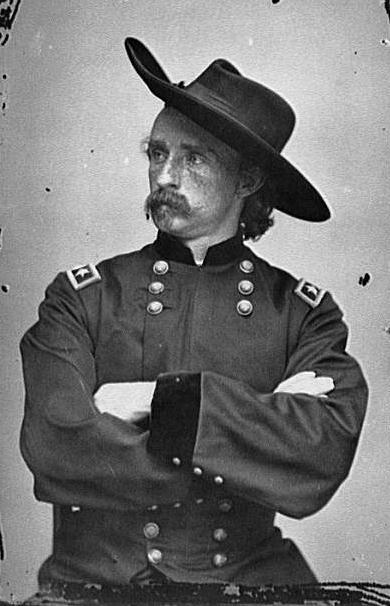
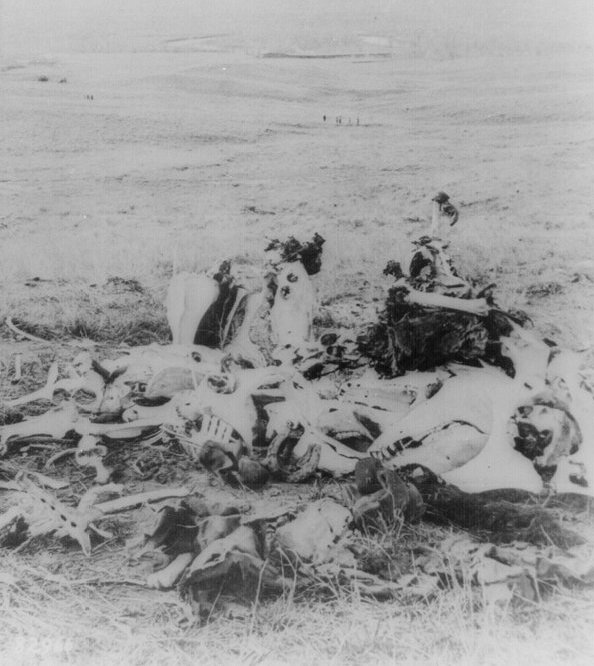
June 25, 1876 - General George A. Custer, leading 250 men, attacked an encampment of Sioux Indians near Little Bighorn River in Montana. Custer and his men were then attacked by 2000-4000 Indian braves. Only one scout and a single horse survived 'Custer's Last Stand' on the Little Bighorn Battlefield. News of the humiliating defeat infuriated Americans and led to all out war. Within a year, the Sioux Indians were a broken and defeated nation.
June 26, 1945 - The United Nations Charter was signed in San Francisco by 50 nations. The Charter was ratified on October 24, 1945.
June 27, 1844: The first telegraph message, “What hath God wrought?”, is sent from Washington, D.C., to Baltimore.
June 28, 1914 - Archduke Francis Ferdinand, Crown Prince of Austria and his wife were assassinated at Sarajevo, touching off a conflict between the Austro-Hungarian government and Serbia that escalated into World War I.
June 29, 1972 - The U.S. Supreme Court ruled (5-4) that capital punishment was a violation of the Eighth Amendment prohibiting "cruel and unusual punishment." The decision spared the lives of 600 individuals then sitting on death row. Four years later, in another ruling, the Court reversed itself and determined the death penalty was not cruel and unusual punishment. On October 4, 1976, the ban was lifted on the death penalty in cases involving murder.
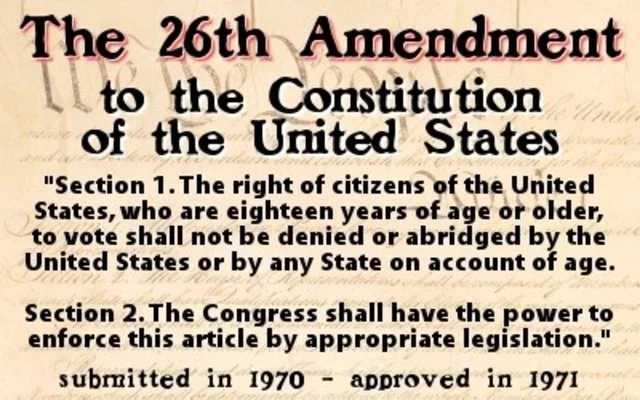
June 30, 1971 - The 26th Amendment to the U.S. Constitution was enacted, granting the right to vote in all federal, state and local elections to American citizens 18 years or older. The U.S. thus gained an additional 11 million voters. The minimum voting age in most states had been 21.
FINAL THOUGHTS
I was looking through my library the other day and noticed so many books I have not read. I keep asking myself, when am I going to find the time to read them? Then I rephrased the question, when am I going to make time to read them? If you’re like me, busy schedules and competing priorities eat away at our time to relax and enjoy a good book. Sometimes, we have to take baby steps to begin our reading journey. First, choose the book of your choice, Secondly, set aside 10-15 minutes a day and commit to reading at least one chapter. I have found in my three score and 2 years of living, that some things are measured from beginning to end, but best understood from end to beginning. I think this applies to reading also. So during the month of June, I encourage you to select a book to read and when you’re finished, don’t forget to write a review for the author on the appropriate website.
Enjoy your summer, stay safe and don’t forget about the three Rs….READ, READ, and READ.